Friday, October 8, 2010

Clifford Teaching at Central Market in Texas

I will be teaching at CENTRAL MARKET in Austin, Dallas, San Antonio, Houston, Ft. Worth, and Southlake from October 18 to 23.  Join me for classes on cooking with cheese, CHEESE: THE ESSENTIAL INGREDIENT.  The dishes I will demonstrate are some old time favorites and some new delights.  Learn how to make French Onion Soup au Gratin, Mexican Three Cheese Soup with Roasted Poblanos, Cheesy Ham Poof, Bacon Noodle Casserole, Palak Paneer, and Tomato Tart with Figs, Fontina, and Goat Cheese.

These will be fun and delicious evenings. Come join me and sign up now at Central Market Cooking School in the city nearest you.

Tomato Tart with Figs, Fontina, and Goat Cheese

Tuesday, September 7, 2010

Sardines


One of the typical seafoods of the coastal Mediterranean are sardines.  Usually they are either deep-fried or they're grilled.  I love them both ways.  In the U.S. sardines are mostly considered bait and one rarely finds them in fish stores.  Sardines are abundant off the coast I live near in southern California, but they sure aren't abundant in the stores.  I think I know the reason they're not popular: most southern Californians trace their heritage to the Midwest and fish cookery was never big--in fact  non-existent--in their families that came from Oklahoma, Missouri, or Michigan.  They passed on to their children and their grandchildren their disinterest in fish.  However, you can't ignore fish when you're on a big ocean, so when they did eat fish they ate fish that didn't look like fish, namely, fish fillets or unrecognizable "white" fish.  So what about those sardines?  Goodness, you could see their eyes and they had bones!

Man, what they're missing.  Of course, I miss the easy access to them.  My local Whole Foods supermarket sells local sardines for $3.99 a pound.  That's great.  Down the street is the fancy-shmancy Santa Monica Seafood selling their sardines (and they are the ONLY 2 places that sell them in all of the West side of Los Angeles, population 1 million I would imagine) for $15 a pound.  Yikes.  I told them I could get then down the street for $3.99.  They said "yeah, but these are from France."  Only in a stark raving mad country like ours would someone want to pay for a first class seat on a plane for a little fish.

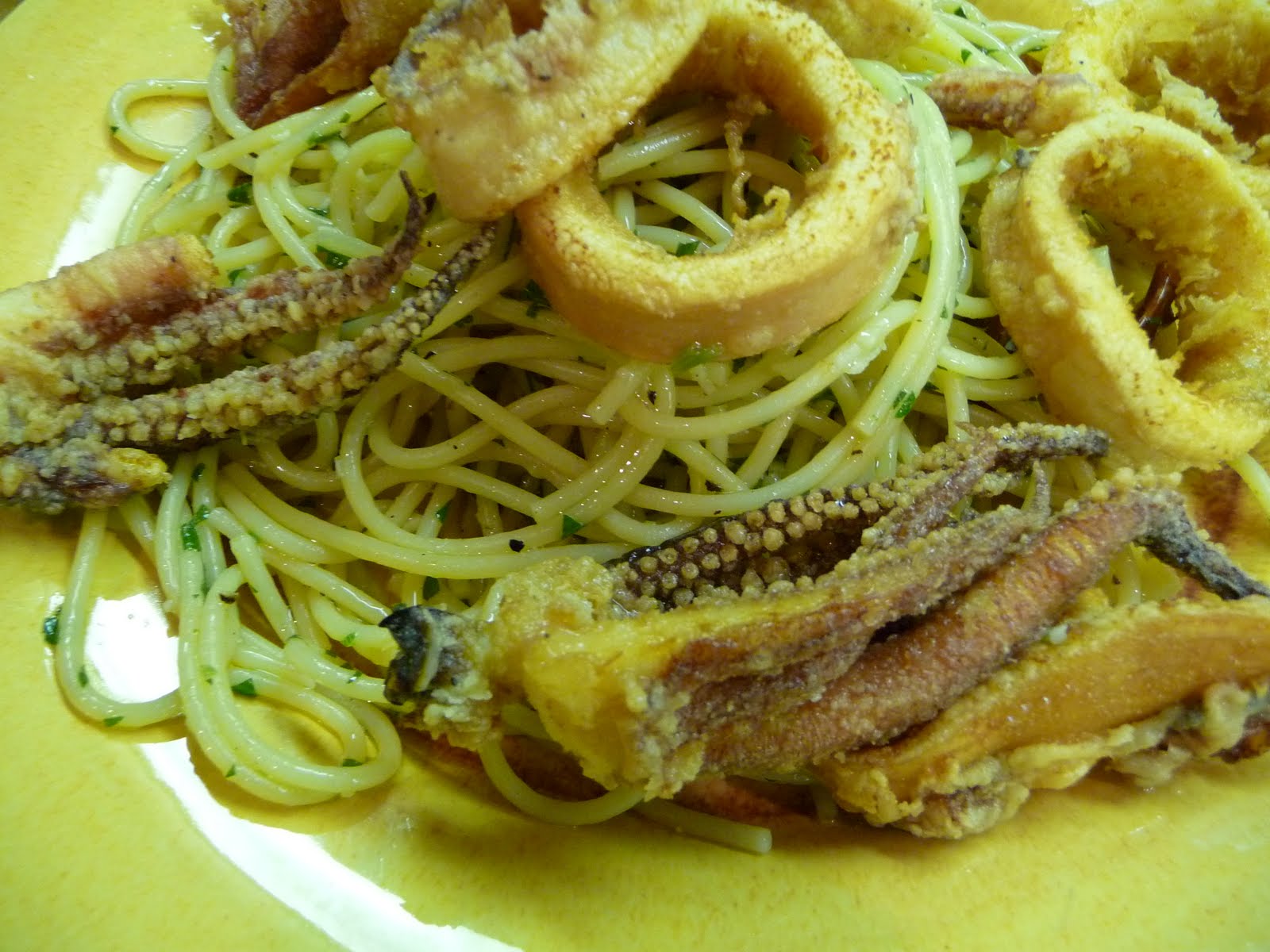
So you've got your sardines.  Gut them, ripping out all the viscera including that in the head too.  Deep-fry them in plenty of olive oil for 2 to 3 minutes.  And then lay them atop of some linguine cooked with olive oil, garlic, parsley, and a dusting of cayenne.  Mighty nice.

[photo: linguine with fried sardines, Clifford A. Wright]

Monday, August 23, 2010

A Week of Great Food

When my friend Boyd visited this week from Baltimore it become a week of great food.  No recipe-testing this week from this cookbook author.  The kids came over ever day and we feasted.  On Tuesday we started with as authentic an ossobuco all Milanese and risotto alla Milanese as you can get.  I made the veal stock for the risotto the day before and I used my ultra-low simmer setting on my stove so it simmered, barely, for about 8 hours.  Wednesday we had a mixed grill of veal sweetbreads, lamb kidney (oh man, those were good), skirt steak, and homemade Italian sausage that I had frozen about a month ago.  Along with it we had frittedda, that Sicilian dish of artichokes, peas, fava, and scallions that I made in June and my favorite Sicilian eggplant dish, mulinciana alla schebbeci, a kind of eggplant seviche, but much more.  Thursday turned into Mexican night and my girlfriend Michelle and son Seri made a 5-course dinner straight from Rick Bayless's Authentic Mexican cookbook.  We had queso fundido, chipotle chile sauce  for our tacos with chorizo and potatoes and tacos al carbon, plus some guacamole and frijoles charros.  On Friday was a break, but Saturday we had our annual lobsterfest, that wonderfully messy affair on the roof deck, juice squirting everywhere and shells a-flying.  We got 10 two-pound lobsters for $5.95 a pound, can you believe it?  Sunday was oysterfest, 100 Blue Point oysters from Long Island that I had my man fly in for our enjoyment.  We bake 24 wrapped in prosciutto and sauced with a balsamic reduction and the rest we ate raw.  Man what a week.  Lotta beer too.

[photo credits: ossobuco, Clifford A. Wright; lobster: Dailymail.com.uk]

Monday, August 2, 2010

The Turk and the Dragon

Facade, Basilica di Santa Croce, Lecce. Photo: Clifford A. Wright


Wherever you look in the Mediterranean lies an untold or unknown story for Americans not well versed in history. The Mediterranean is so rich in history it’s dizzying and sometimes one will feel overwhelmed especially if you go unprepared. The more you know the more you get out of a trip to the Mediterranean. Here’s one little example found in the unique Baroque style of the Basilica di Santa Croce in Lecce in Italy’s Salento Peninsula. The principals responsible for the structure were Gabriele Riccardi who began work in 1549 and Francesco Antonio Zimbalo, Cesare Penna, and Giuseppe Zimbalo who continued adding layer upon layer for the next 100 years. What you see today is the decorative symbolism creating an allegorical feast that can be digested only if you know the story.

This detailed photo of the exterior shows one of the Turkish prisoners from Battle of Lepanto (1571), one of the most important and significant battles in history. The dragon was the symbol of the Boncompagni, family of Pope Gregory XVI. Behind these stone workings lies a culture that appreciated the Baroque, yet the food of the town is not Baroque. It’s simple food based to a large extent on homemade dried pasta, even to this day, and simple vegetables such as chicory, fava beans, and other legumes. However, an appreciation of the food of Lecce, or Apulia for that matter, will be enriched by understanding the economic and cultural background of the people of the Salento Peninsula. This can be analogous to how much you would want to know about the Turk and the dragon on the façade off Santa Croce and what led men to build it.

Thursday, July 29, 2010

Surprising Soups

When I wrote THE BEST SOUPS IN THE WORLD the hardest part was cutting down the nearly 2,000 soups I wanted to include to the 250 that actually made it into the book. So, when I'm asked what's my favorite soup it's all 250. But I keep thinking of more soups I wish I had included. On the other hand some surprising soups have found their way into the book such as Alexander Dumas' Shrimp and Tomato Soup. You'll find it in THE BEST SOUPS IN THE WORLD.
 [Photo: Clifford A. Wright]

Thursday, July 22, 2010

Cold Soup from the Balkans

This soup and hundreds more can be found in my book THE BEST SOUPS IN THE WORLD. This cold summertime soup is a favorite in Bulgaria and Macedonia. It's called tarator. In fact, a thicker version is used as a meze dip in Greece and Turkey and called tzatziki and cacık respectively. In Arab countries of the Middle East, though, taratur is a sauce made with tahini and lemon juice. The blend of yogurt, walnuts, cucumber, and garlic seems so natural and the dish is made all the more appealing by stirring in a good quality olive oil. I once made tarator on a hot July 4th followed by some yogurt-and-mint-marinated grilled lamb and it was as perfect a meal as could be. For a slightly lighter taste you can use vegetable or sunflower seed oil.
1 pound (2 cups) plain whole yogurt
3 cucumbers, peeled and finely grated
8 large garlic cloves, pounded in a mortar with 1 teaspoon salt until mushy
2 1/2 ounces (about 3/4 cup) shelled walnuts
1/4 cup extra-virgin olive oil
Water if necessary
1 bunch dill, stems removed, chopped
In a bowl, beat the yogurt until smooth. Add the cucumbers, garlic mixture, and walnuts and mix well. Add the oil and beat until well blended. If your yogurt was quite thick, add some water to thin it and make it soupy. Let rest in the refrigerator for 2 hours before serving. Stir the dill in at the last moment and serve.
Makes 4 to 6 servings

[photo credit: Borovets Vacations, 2005]

Wednesday, July 14, 2010

Chilled Summer Soups from Andalusia

The famous gazpacho of Andalusia is one of our favorites soups for summer, but there are other wonderful chilled Andalusian soups such as Ajo Blanco. This recipe comes from my book The Best Soups in the World.

Ajo Blanco
This cold summer soup comes from Málaga in the Spanish region of Andalusia and is a kind of white gazpacho with a medieval history. It is thought to have its roots during the era of Islamic Spain between the eighth and fifteenth century. This soup is an almond-flavored soup usually served with Muscat grapes. A proper ajo blanco is a perfect emulsion of ground almond, olive oil, bread, and garlic. Its whiteness comes from the almonds. Peel the grapes by dropping them in boiling water for about a minute and a half; it’s slightly tedious to peel them, but it’s for the better.
5 ounces Italian or French bread, crusts removed
1 1/2 cups blanched whole almonds (about 1/4 pound)
2 large garlic cloves
1 teaspoon salt or more to taste
2/3 cup extra-virgin olive oil
1 tablespoon sherry vinegar
4 cups cold water
1 pound seedless green grapes, peeled (see headnote)
1. Soak the bread in some water for a minute then squeeze dry.
2. In a food processor, crush the almonds with the bread, garlic, and 1 teaspoon salt until pasty. Pour the olive oil through the feed tube as the machine is running in a slow stream. Blend in the vinegar and 3/4 cup of the water through the feed tube and run continuously for 1 minute. Transfer to a blender and process even finer at high speed for 2 minutes.
3. Transfer the almond mixture to a bowl and whisk in the remaining cold water. Refrigerate for a few hours. Remove from the refrigerator and add more salt or vinegar if needed. Serve very cold with the grapes sprinkled in the bowls.
Makes 4 servings

Monday, June 7, 2010

Grilled Salad from Tunisia

The ingredients of this salad called Salāṭa Mishwiyya in Arabic, the New World tomatoes and peppers having been introduced by the Spanish, are all grilled then tossed together. It is a very popular salad throughout Tunisia and one is likely to encounter it many times in ones travels in country. I first ate it in Djerba, where it typically accompanies other grilled food. You can double the recipe easily.
½ pound ripe, but firm, tomatoes
2 green bell peppers (about ¾ pound)
4 fresh red chiles (about ½ pound)
1 medium-size onion, peeled and quartered
2 garlic cloves, peeled
4 ½ teaspoons caraway seed
¾ teaspoon salt
3 tablespoons extra-virgin olive oil
1 tablespoon fresh lemon juice
24 imported black olives, pitted or whole
One 3 ½-ounce can imported tuna in olive oil, drained and flaked apart
2 hard-boiled eggs, shelled and quartered
1. Prepare a hot charcoal fire or preheat a gas grill on high for 20 minutes.
2. Grill the tomatoes, peppers, and onion until all have blackened and blistered peels or black grid marks, about 15 minutes for the smaller peppers and tomatoes, and about 20 to 25 minutes for the bell peppers and onion.
3. Peel and seed the grilled vegetables, cut them up, and place in a food processor. Process with 4 or 5 short pulses and transfer to a medium-size bowl. (You can also chop them coarsely with a chef’s knife).
4. Pound the garlic, caraway seeds, and salt together in a mortar with a pestle until almost a paste. Transfer to a bowl and stir in the grilled vegetables. Arrange on a platter, drizzle with the olive oil and lemon juice, and garnish with the olives, pieces of tuna, and quartered eggs.
Makes 4 servings

Friday, May 7, 2010

Summer Joy


When we were growing up in New York, calamari was as common and beloved a food as any. My jaw would drop in saddened amazement when Midwesterners, or for that matter anybody who didn't live on the East coast, would call them rubber bands. We knew that if their texture was like rubber bands they weren't cooked properly. One of my favorite dishes is spaghetti with fried calamari. This is a harbinger of summer even more than shoots poking out of the ground. It means a world of grilled seafood is on the horizon. Pasta is the perfect food to accompany calamari as in this recipe.


Linguine with Calamari

1/4 cup extra-virgin olive oil
3 large garlic cloves, finely chopped
5 tablespoons finely chopped fresh parsley
1/4 teaspoon red chile flakes
6 to 8 cups olive oil for frying
1 pound cleaned squid bodies, cut into rings
1 cup all-purpose flour for dredging
Salt to taste
1/2 cup milk
3/4 pound linguine
1. In a small skillet, heat the olive oil, garlic, half the parsley, and red chile, over low heat. Turn off the heat before it starts sizzling.
2. In a deep fryer or an eight-inch diameter saucepan fitted with a wire fry basket preheat the oil to 360 degrees F. Preheat the oven to 150 degrees F or “warm.”
3. Meanwhile, dredge the squid in the flour and salt and shake off the excess flour in a strainer. Cook the squid in batches, by the handful, dipping them first in the milk rather quickly. Make sure you don’t crowd the fryer. Cook the squid until light golden, 3 to 4 minutes. Drain and place on a paper towel-lined platter and keep warm in the oven while you cook the pasta.
4. Meanwhile, bring a large pot of water to a vigorous boil over high heat, salt abundantly, and add the pasta. Cook, stirring occasionally, until al dente and drain well without rinsing. Transfer the pasta to a serving bowl or platter. Sprinkle the fried squid on top, then sprinkle the remaining parsley on top, and serve.
Makes 4 servings

Friday, April 23, 2010

Spring Vegetables - Artichokes and Fava


photo: fava bean puree, Clifford A. Wright

In Syria, there couldn’t be two more favored vegetables than artichokes and fava beans, kharshūf wa’l-fūl, except for maybe the eggplant. This simple preparation is served at room temperature and is a favorite in Damascus in the spring when artichokes and fava beans come to market. Some of the fava beans available are so young that they do not need to be peeled. If your fava beans are older you will want to peel them after boiling for 5 minutes. Although this is more work, the bright green color makes it so appetizing and, frankly, the peel is really too indigestible.
9 medium-size artichokes (about 3 pounds), trimmed
Water with lemon juice in a bowl
4 large garlic cloves, peeled
1 teaspoon salt
3 pounds fava bean pods (3 cups shelled beans)
½ cup extra-virgin olive oil
1 tablespoon sugar
1 tablespoon finely chopped fresh parsley leaves
1. Prepare the artichokes according to the instructions here and place the hearts in bowl of acidulated water.
2. In a mortar, pound the garlic with 1 teaspoon salt until mushy. Dice the artichokes and place in a large skillet with the fava beans, olive oil, garlic, sugar, and ¾ cup of the acidulated water in which the artichokes soaked. Bring to a boil over medium-high heat, about 6 minutes. Reduce to low and simmer, covered, for 45 minutes.
3. Uncover, taste, and correct the seasoning, then simmer another 10 to 15 minutes. Transfer to a serving dish, sprinkle with parsley and serve at room temperature.
Makes 4 to 6 servings

Wednesday, March 17, 2010

One of the Best Soups in the World - Fava Bean Soup


This soupe de fèves is one that Odette Cocula, a neighbor of my father’s when he lived in his adopted village of Frayssinet near Cahors in the Lot department of France, would prepare for him occasionally in the springtime. It’s a hearty soup typical of the region. You’ll need about four pounds of fava bean pods to yield three cups of double-peeled beans. The recipe is in my book THE BEST SOUPS IN THE WORLD.
3 tablespoons rendered duck fat (preferably), chicken fat, or unsalted butter
1 medium onion, finely chopped
3 large garlic cloves (2 whole, 1 cut in half)
2 leeks, white part only, split lengthwise, washed and sliced
1 tablespoon tomato paste or 1 ripe plum tomato, peeled and finely chopped
2 medium russet potatoes (about 3/4 pound), peeled and diced
10 cups chicken broth
3 cups double-peeled fresh fava beans (see Note)
Salt and freshly ground black pepper to taste
8 slices French or Italian country bread
1. In a large pot or flame-proof casserole, melt the duck fat over medium-high heat, then cook, stirring frequently, the onion, 2 whole garlic cloves, and the leeks until soft, about 15 minutes.
2. Stir in the tomato paste and cook for 1 to 2 minutes. Add the potatoes and chicken broth and simmer 1 hour. Use a potato masher to slightly crush the vegetables. Add the fava beans and cook for 5 minutes, then season with salt and pepper.
3. Toast the slices of bread in a preheated broiler or a counter top oven. Rub the bread on both sides with the cut side of the remaining garlic clove. Place a slice of bread in a soup bowl and ladle the soup on top. Serve hot.
Makes 8 servings
Note: Double-peeled beans means that the bean is taken out of its pod and its skin is pinched off after being dropped in boiling water for a couple of minutes to loosen it.

Tuesday, February 23, 2010

Cassoulet


Many dishes in the Mediterranean have apocrypha associated with their origin that I find charming. It makes the eating of these dishes all the better. One typical phenotype is the “besieged castle” origination. Cassoulet fits that bill. Cassoulet is a bean stew cooked in an earthenware casserole, hence the name, both words deriving from the same root. It is one of the classic dishes of the Languedoc, and of France. This famous bean stew—and “bean stew” hardly conveys the complexity of its flavors—is subject to much debate about what constitutes a “true” cassoulet. Cassoulet is a paradigm for a culinary understanding of the Languedoc, for there is a different recipe in every kitchen.

The history of cassoulet is a history of Languedoc. One legend places the birth of cassoulet during the siege of Castelnaudary by the Black Prince, Edward the Prince of Wales, in 1355. The besieged townspeople gathered their remaining food to create a big stew cooked in a cauldron. Apocrypha aside, a more appropriate historical question can be asked: Is the prototype of cassoulet the fava and mutton stews of the Arabs, as suggested by Julia Child and Paula Wolfert (but denied by Waverly Root)? Was the Languedoc the northern limit of the cooks, if not the commandos, of 'Abd ar-Raḥmān I and the yakhna bi’l-fūl (fava bean stew? Etymology alone provides some circumstantial evidence pointing to the celebrated cuisine of the Arabs as the provenance of cassoulet, already having made its mark on the beans stews to the south in Muslim Spain.


The word cassoulet derives from the earthenware pot it is cooked in, the cassolle or cassolo, a special vessel made by the local potteries from the terre d’Issel, Issel being a village near Castelnaudary. The word cassolo comes directly from the Spanish. But where does the Spanish word cassa, meaning “a receptacle for carrying liquid,” from which it derives come from? Possibly it is the Mozarab word cacherulo, derived from the Arabic qas'at, a large shallow bowl or pan, or it may be derived from a proto-Hispanic word.


This is the perfect time of year for cassoulet, as rib-sticking a meal as you’ll ever have. It’s heavy so best had around 4 in the afternoon on a cold Sunday. You’ll want to make only the most authentic cassoulet so follow my recipe.