The ingredients of this salad called Salāṭa Mishwiyya in Arabic, the New World tomatoes and peppers having been introduced by the Spanish, are all grilled then tossed together. It is a very popular salad throughout Tunisia and one is likely to encounter it many times in ones travels in country. I first ate it in Djerba, where it typically accompanies other grilled food. You can double the recipe easily.
½ pound ripe, but firm, tomatoes
2 green bell peppers (about ¾ pound)
4 fresh red chiles (about ½ pound)
1 medium-size onion, peeled and quartered
2 garlic cloves, peeled
4 ½ teaspoons caraway seed
¾ teaspoon salt
3 tablespoons extra-virgin olive oil
1 tablespoon fresh lemon juice
24 imported black olives, pitted or whole
One 3 ½-ounce can imported tuna in olive oil, drained and flaked apart
2 hard-boiled eggs, shelled and quartered
1. Prepare a hot charcoal fire or preheat a gas grill on high for 20 minutes.
2. Grill the tomatoes, peppers, and onion until all have blackened and blistered peels or black grid marks, about 15 minutes for the smaller peppers and tomatoes, and about 20 to 25 minutes for the bell peppers and onion.
3. Peel and seed the grilled vegetables, cut them up, and place in a food processor. Process with 4 or 5 short pulses and transfer to a medium-size bowl. (You can also chop them coarsely with a chef’s knife).
4. Pound the garlic, caraway seeds, and salt together in a mortar with a pestle until almost a paste. Transfer to a bowl and stir in the grilled vegetables. Arrange on a platter, drizzle with the olive oil and lemon juice, and garnish with the olives, pieces of tuna, and quartered eggs.
Makes 4 servings
Monday, June 7, 2010
Friday, May 7, 2010
Summer Joy
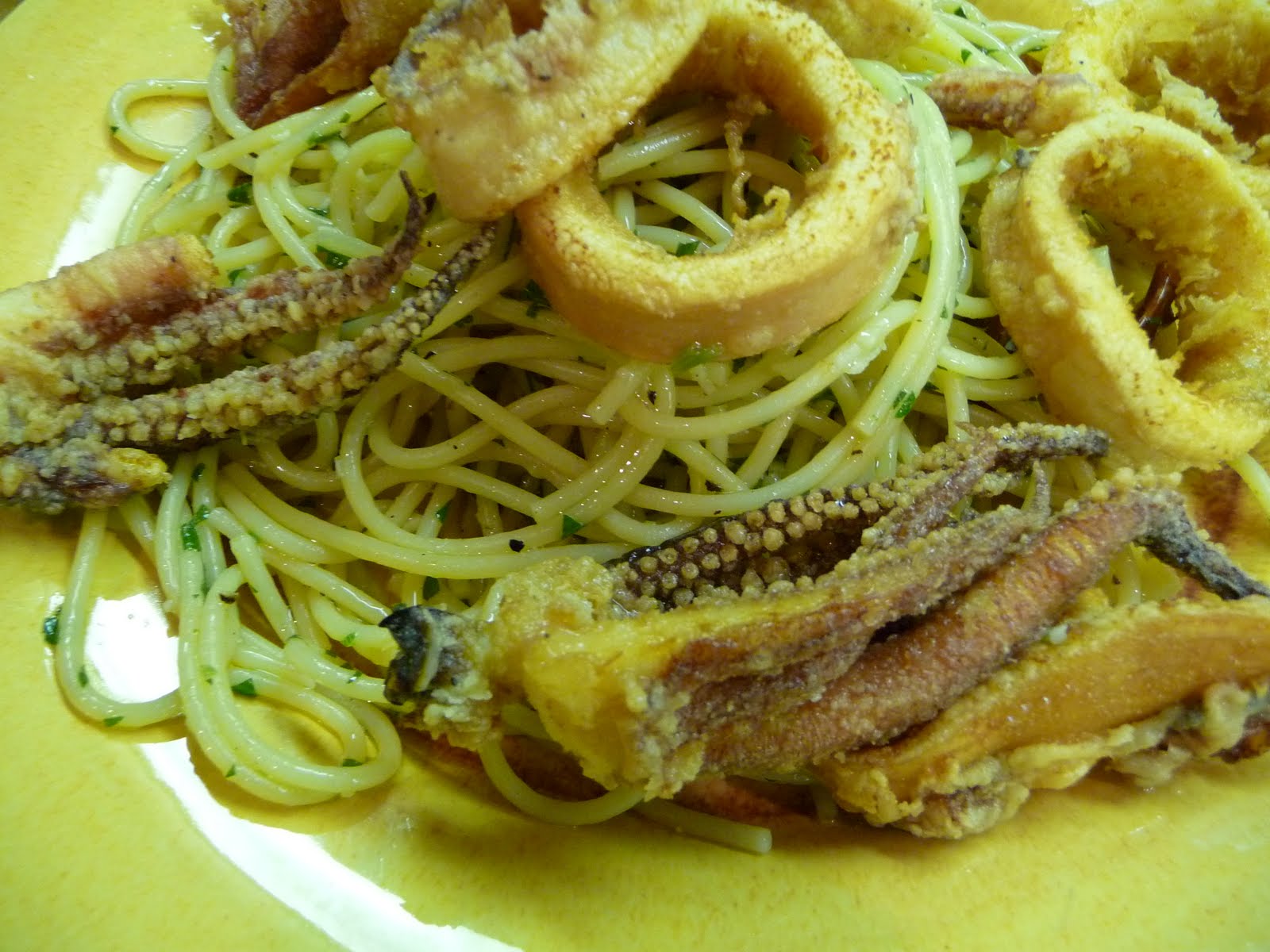
When we were growing up in New York, calamari was as common and beloved a food as any. My jaw would drop in saddened amazement when Midwesterners, or for that matter anybody who didn't live on the East coast, would call them rubber bands. We knew that if their texture was like rubber bands they weren't cooked properly. One of my favorite dishes is spaghetti with fried calamari. This is a harbinger of summer even more than shoots poking out of the ground. It means a world of grilled seafood is on the horizon. Pasta is the perfect food to accompany calamari as in this recipe.
Linguine with Calamari
1/4 cup extra-virgin olive oil
3 large garlic cloves, finely chopped
5 tablespoons finely chopped fresh parsley
1/4 teaspoon red chile flakes
6 to 8 cups olive oil for frying
1 pound cleaned squid bodies, cut into rings
1 cup all-purpose flour for dredging
Salt to taste
1/2 cup milk
3/4 pound linguine
1. In a small skillet, heat the olive oil, garlic, half the parsley, and red chile, over low heat. Turn off the heat before it starts sizzling.
2. In a deep fryer or an eight-inch diameter saucepan fitted with a wire fry basket preheat the oil to 360 degrees F. Preheat the oven to 150 degrees F or “warm.”
3. Meanwhile, dredge the squid in the flour and salt and shake off the excess flour in a strainer. Cook the squid in batches, by the handful, dipping them first in the milk rather quickly. Make sure you don’t crowd the fryer. Cook the squid until light golden, 3 to 4 minutes. Drain and place on a paper towel-lined platter and keep warm in the oven while you cook the pasta.
4. Meanwhile, bring a large pot of water to a vigorous boil over high heat, salt abundantly, and add the pasta. Cook, stirring occasionally, until al dente and drain well without rinsing. Transfer the pasta to a serving bowl or platter. Sprinkle the fried squid on top, then sprinkle the remaining parsley on top, and serve.
Makes 4 servings
Friday, April 23, 2010
Spring Vegetables - Artichokes and Fava

photo: fava bean puree, Clifford A. Wright
In Syria, there couldn’t be two more favored vegetables than artichokes and fava beans, kharshūf wa’l-fūl, except for maybe the eggplant. This simple preparation is served at room temperature and is a favorite in Damascus in the spring when artichokes and fava beans come to market. Some of the fava beans available are so young that they do not need to be peeled. If your fava beans are older you will want to peel them after boiling for 5 minutes. Although this is more work, the bright green color makes it so appetizing and, frankly, the peel is really too indigestible.
9 medium-size artichokes (about 3 pounds), trimmed
Water with lemon juice in a bowl
4 large garlic cloves, peeled
1 teaspoon salt
3 pounds fava bean pods (3 cups shelled beans)
½ cup extra-virgin olive oil
1 tablespoon sugar
1 tablespoon finely chopped fresh parsley leaves
1. Prepare the artichokes according to the instructions here and place the hearts in bowl of acidulated water.
2. In a mortar, pound the garlic with 1 teaspoon salt until mushy. Dice the artichokes and place in a large skillet with the fava beans, olive oil, garlic, sugar, and ¾ cup of the acidulated water in which the artichokes soaked. Bring to a boil over medium-high heat, about 6 minutes. Reduce to low and simmer, covered, for 45 minutes.
3. Uncover, taste, and correct the seasoning, then simmer another 10 to 15 minutes. Transfer to a serving dish, sprinkle with parsley and serve at room temperature.
Makes 4 to 6 servings
Wednesday, March 17, 2010
One of the Best Soups in the World - Fava Bean Soup

This soupe de fèves is one that Odette Cocula, a neighbor of my father’s when he lived in his adopted village of Frayssinet near Cahors in the Lot department of France, would prepare for him occasionally in the springtime. It’s a hearty soup typical of the region. You’ll need about four pounds of fava bean pods to yield three cups of double-peeled beans. The recipe is in my book THE BEST SOUPS IN THE WORLD.
3 tablespoons rendered duck fat (preferably), chicken fat, or unsalted butter
1 medium onion, finely chopped
3 large garlic cloves (2 whole, 1 cut in half)
2 leeks, white part only, split lengthwise, washed and sliced
1 tablespoon tomato paste or 1 ripe plum tomato, peeled and finely chopped
2 medium russet potatoes (about 3/4 pound), peeled and diced
10 cups chicken broth
3 cups double-peeled fresh fava beans (see Note)
Salt and freshly ground black pepper to taste
8 slices French or Italian country bread
1. In a large pot or flame-proof casserole, melt the duck fat over medium-high heat, then cook, stirring frequently, the onion, 2 whole garlic cloves, and the leeks until soft, about 15 minutes.
2. Stir in the tomato paste and cook for 1 to 2 minutes. Add the potatoes and chicken broth and simmer 1 hour. Use a potato masher to slightly crush the vegetables. Add the fava beans and cook for 5 minutes, then season with salt and pepper.
3. Toast the slices of bread in a preheated broiler or a counter top oven. Rub the bread on both sides with the cut side of the remaining garlic clove. Place a slice of bread in a soup bowl and ladle the soup on top. Serve hot.
Makes 8 servings
Note: Double-peeled beans means that the bean is taken out of its pod and its skin is pinched off after being dropped in boiling water for a couple of minutes to loosen it.
Tuesday, February 23, 2010
Cassoulet
Many dishes in the Mediterranean have apocrypha associated with their origin that I find charming. It makes the eating of these dishes all the better. One typical phenotype is the “besieged castle” origination. Cassoulet fits that bill. Cassoulet is a bean stew cooked in an earthenware casserole, hence the name, both words deriving from the same root. It is one of the classic dishes of the Languedoc, and of France. This famous bean stew—and “bean stew” hardly conveys the complexity of its flavors—is subject to much debate about what constitutes a “true” cassoulet. Cassoulet is a paradigm for a culinary understanding of the Languedoc, for there is a different recipe in every kitchen.
The history of cassoulet is a history of Languedoc. One legend places the birth of cassoulet during the siege of Castelnaudary by the Black Prince, Edward the Prince of Wales, in 1355. The besieged townspeople gathered their remaining food to create a big stew cooked in a cauldron. Apocrypha aside, a more appropriate historical question can be asked: Is the prototype of cassoulet the fava and mutton stews of the Arabs, as suggested by Julia Child and Paula Wolfert (but denied by Waverly Root)? Was the Languedoc the northern limit of the cooks, if not the commandos, of 'Abd ar-Raḥmān I and the yakhna bi’l-fūl (fava bean stew? Etymology alone provides some circumstantial evidence pointing to the celebrated cuisine of the Arabs as the provenance of cassoulet, already having made its mark on the beans stews to the south in Muslim Spain.
The word cassoulet derives from the earthenware pot it is cooked in, the cassolle or cassolo, a special vessel made by the local potteries from the terre d’Issel, Issel being a village near Castelnaudary. The word cassolo comes directly from the Spanish. But where does the Spanish word cassa, meaning “a receptacle for carrying liquid,” from which it derives come from? Possibly it is the Mozarab word cacherulo, derived from the Arabic qas'at, a large shallow bowl or pan, or it may be derived from a proto-Hispanic word.
This is the perfect time of year for cassoulet, as rib-sticking a meal as you’ll ever have. It’s heavy so best had around 4 in the afternoon on a cold Sunday. You’ll want to make only the most authentic cassoulet so follow my recipe.
Monday, February 1, 2010
Mediterranean Soups with History

Many dishes in the Mediterranean have colorful stories concerning their origins. Most of these are apocryphal but nevertheless amusing. One such soup is zuppa Pavese. An important moment in food history was the great battle at Pavia in northern Italy in 1525 between Charles V of Spain (1500--1558) and the defeated King Francis I of France (1494--1547). The French historian Fernand Braudel suggested that the Battle of Pavia, besides being a triumph of the harquebusiers, was also the triumph of empty stomachs because Francis’s army was too well fed, while the Spaniards and Lombards he fought could make do with a simple broth. Legend has it that Francis, before his capture, took refuge in a nearby farmhouse after the battle. The embarrassed, yet deeply honored, housewife was preparing some soup. She had to turn her humble soup into a soup fit for a king, so she fried some stale bread, put it into the soup, and cracked in two newly laid eggs and ladled some boiling broth over the eggs. The whites curdled gently and the yolks remained soft. She served it with grana padano cheese and the king approved, asking that the recipe be given to one of his servants. And so was born zuppa pavese, the famous egg-drop soup from Pavia. The crucial element to this soup is the broth and the eggs. The broth should be clear, flavorful, and homemade. The eggs must be at room temperature.
ZUPPA PAVESE
2 tablespoons unsalted butter
4 slices French or Italian bread with crust
1/4 cup freshly grated Parmesan cheese (preferably, imported Parmigiano-Reggiano cheese)
1 1/2 quarts Rich Veal Broth (see variation here)
4 small or medium eggs, at room temperature
1 tablespoon finely chopped fresh parsley
Freshly ground white pepper to taste
1. Preheat the oven to 200 degrees F and warm four ovenproof soup bowls for at least 30 minutes.
2. In a large skillet, melt the butter over medium heat, then cook the bread on both sides until golden, making sure you do not blacken the edges. Place a slice of bread in each bowl. Sprinkle a tablespoon of Parmesan on each slice of bread.
3. In a pot, bring the broth to a rolling boil over high heat. Without breaking the yolk, crack 1 egg onto each slice of bread and carefully ladle or pour the boiling broth over the egg until the bowl is filled. Sprinkle with parsley and a pinch of white pepper and serve immediately. Add more Parmesan at the table if desired.
Note: The broth must be boiling furiously before you pour it into the bowls, so the eggs, which are small or medium and not large, can cook a bit.
Makes 4 servings
Zuppa Pavese and many more soups are found in THE BEST SOUPS IN THE WORLD
Wednesday, January 20, 2010
Mediterranean Soups in America

We are a lucky nation to have so many different cultures and ethnic groups creating an American food. The Portuguese who settled in southestern Massachusetts have given us a wonderful soup from the Old World. It's from my new book THE BEST SOUPS IN THE WORLD
Portuguese Kale Soup
It may be called Portuguese kale soup or caldo verde, but this dish is a classic of Portuguese-American cookery as found from Fall River and New Bedford, Massachusetts, east to Cape Cod, where many Portuguese immigrants settled in the late nineteenth century. This version is my attempt to approximate the one I ate regularly at P.J.’s Dari-Burger in Wellfleet on the Cape during our summer vacations. The key ingredient here, besides freshness, is the fresh linguiça sausage. Supermarkets usually carry it on the East Coast, but elsewhere you may need to substitute the fully cooked version, and if you can’t find that, then sweet Italian sausage or kielbasa.
1/4 cup extra-virgin olive oil
1/2 pound (about 1 link) fresh Portuguese linguiça or chourico, casing removed
1 large onion, chopped
4 cups chicken broth
2 cups water
1 1/2 pounds russet potatoes, peeled and thinly sliced
1 pound kale leaves, heavy stems removed, laid on top of one another, rolled up, and sliced 1/4 inch thick
2 1/2 teaspoons salt or more to taste
1/2 teaspoon freshly ground black pepper or more to taste
1. In a large pot, heat the olive oil over medium heat, then add the sausage and onion and cook, stirring occasionally and breaking up the sausage but leaving largish chunks, until the onion is softened, about 10 minutes.
2. Add the chicken broth, water, potatoes, and kale. Bring to a boil over high heat, then reduce to low and simmer, partially covered, until the potatoes are softened and almost falling apart, about 1 ½ hours. The potatoes are meant to fall apart and thicken the broth. Season with salt and pepper and serve. Break up the potatoes further in your bowl to make it thicker.
Makes 4 to 6 servings
Thursday, January 7, 2010
Garlic is a Spice

In the Middle Ages, the term spices was applied to all costly goods (except gems) imported to Europe from the East, and extended to items no longer commonly called spices, such as dyes, drugs, perfumes, textile fibers, aphrodisiacs, and sugar, as well as what we today call spices, like pepper (meaning peppercorns), cardamom, ginger, turmeric, various herbs, the chilies (newly arrived from America), garlic (called the peasant’s theriaca by the thirteenth-century doctor Arnold of Vilanova), and saffron, a true luxury.
Garlic is a spice, yet even though its history in the Mediterranean is very old, the mad desire of Europeans for the exotic spices of the East led them to overlook garlic. Europeans traded gold and silver for the spices of the East, a fact that displeased kings and finance ministers, who thought it a poor trade. Ferdinand of Spain tried to stop the importing of cinnamon and pepper in exchange for silver by saying, “Buena especia es el ajo” (Garlic is a perfectly good spice). However, popular opinion held that garlic “sempre è cibo rusticano” (always is a peasant food), although with the right preparation it could become gentlemen’s food. Perhaps garlic is the “plant of civilization.” It enlivens food.
In the meantime, try this garlic soup. More garlic soups are in my latest book Best Soups in the World.
Tuesday, December 29, 2009
Tuscan White Bean Soup
This smooth soup or velouté is the height of simplicity nevertheless any diner eating it will ask you for the recipe because its taste is soothing and delicious. You can find this recipe and a couple of hundreds more in my new book The Best Soups in the World. Tuscans favor a variety of small white navy beans, called cannellini beans, and use them to make a thicker version of this soup into a spread for crostini (toast points) as an antipasto. If you leave the carrot out, the soup will be whiter.
1 cup (1/2 pound) dried white beans
1 leafy sprig fresh sage
Salt to taste
1/4 cup extra-virgin olive oil
1/2 small onion, finely chopped
2 large garlic cloves, finely chopped
1 celery stalk, finely chopped
1 small carrot, peeled and finely chopped
1/4 cup finely chopped fennel bulb (optional)
For the garnish (choose 1)
Twelve 1-inch squares thinly sliced pancetta, cooked until crispy
1 cup croûtons, fried in olive oil until golden
1/2 cup cooked tiny shrimp
1 tablespoon finely chopped fresh parsley
1. Place the beans in a pot with 1 sprig sage and cover with water by several inches, but first pull off two leaves of sage from the sprig and set aside for later. Bring to a boil over high heat, salt lightly, and then cook at a boil until tender, about 1 1/2 hours, replenishing the water when necessary.
2. Meanwhile, heat the olive oil in a skillet over medium-high heat, then cook, stirring, the onion, garlic, celery, carrot, and fennel, if using, until soft, about 6 minutes.
3. Drain the beans, saving 4 cups of the cooking liquid. Place the beans in a blender with the vegetables from the skillet and 4 cups of the cooking liquid. Blend until smooth. Transfer to a clean pot, add the 2 leaves of sage, and turn the heat to low. Cook until bubbling and hot, about 5 minutes. Serve hot with one of the garnishes.
Makes 4 servings
Thursday, December 10, 2009
Soups from the Mediterranean
Paparòt is an interesting spinach soup from Friuli-Venezia Giulia, the region of northeastern Italy, and is far more exciting than its humble list of ingredients would indicate. It’s a spinach soup made with fine cornmeal flour used as a thickening agent. Paparòt, in the dialect of Friuli, means “pulped” used as a noun (in other words “pulped soup”) and indicates that the spinach is treated like a pesto but is pulped by chopping rather than pounding in a mortar. The kind of cornmeal to use is the one used for polenta, and I prefer the slightly coarser one because I enjoy the resulting gruel-like texture. The taste is surprisingly rich and filling.
The recipe is in my latest book THE BEST SOUPS IN THE WORLD
Monday, November 30, 2009
The Best Soups in the World

This December my newest book THE BEST SOUPS IN THE WORLD will be published. This is my 14th book and one of the most fun to write. The title came about partly because I simply spent so much time choosing ones that would go in and so many that didn’t make the cut. Here’s a sample recipe:
Dubrovnik Fish Soup
The proximity of the Italian peninsula and the naval dominance of the Venetian Republic during the Middle Ages resulted in a perceptible Italian culinary influence along the Dalmatian coast, where fish soups are called brodet in Serbo-Croatian, from the Italian brodetto. But this recipe came to me by way of someone calling it in Serbo-Croatian, čorba, deriving not from the Italian, but the Turkish and Arabic words for “soup.” It’s a simple fish boil called riblja čorba na Dubrovaćki naćin, a soup from Dubrovnik which will be successful if you have a good mix of fish, at least four kinds, and a whole fish from which to make the broth. A good mix would be a whole striped bass, whole porgy (scup), and fillets from bluefish, cod, and salmon. You can ask the fishmonger to fillet the whole fish for you, keeping the heads, tails, and carcass for the broth.
3 1/2 pounds mixed fish steaks, pieces, heads, carcasses (see above), including whole fish, cut-up
12 cups water
Sea salt to taste
1 cup dry white wine
1 large ripe tomato (about 1/2 pound), peeled, seeded, and chopped
1/4 cup finely chopped fresh parsley
1/4 cup extra-virgin olive oil
10 black peppercorns
1 bay leaf
1/2 cup medium grain rice
1. Place the fish heads, tails, and carcasses (1 to 1 1/2 pounds all together) in a large pot and cover with 6 cups of the water. Bring to a boil over high heat, reduce the heat to medium and simmer for 1 hour. Strain the fish broth through a cheesecloth-lined strainer and set aside. You should have about 1 quart fish broth.
2. Pour the remaining 6 cups of water into a large pot and season with sea salt. Add the wine, tomato, parsley, oil, peppercorns, and bay leaf and bring to a rolling boil. Add the fish pieces to the boiling broth one at a time and boil furiously for 8 to 10 minutes.
3. Meanwhile, bring the reserved fish broth to a boil in a medium-size saucepan, add the rice, and cook until almost tender (times vary, so keep checking). Turn the heat off.
4. Put about 2 or 3 tablespoons of the cooked rice in each individual serving bowl using a slotted ladle. Ladle the fish with broth over the rice and serve.
Makes 4 servings
Friday, November 13, 2009
La Serenissima
.jpg)
Business was good in the fourteenth-century Mediterranean and that meant towns got bigger. Venice was soon the most important city in the Mediterranean. Venetian ships were in the thick of it, and their agents were located in both gateways to spices, silk, and other products of the East, name, Syria and Egypt. The success of the merchants of Venice depended on these gateways, Syria perhaps being the more important of the two, assisting in the growth of the ancient city of Aleppo, the terminus of a number of trade routes. The riches made from this trade with both Syria and Egypt was incredible because the demand was incredible. Venice did have manufactured products to trade, but in reality, it sacrificed all its valuable metal currency to meet the powerful demand for black pepper, spices, drugs, cotton, linens, and silk. The trade between Egypt and Venice, usually transshipped through Crete, was intense even in 1350. Crete was an entrepôt for spices from Beirut and Alexandria, too. As Venice grew richer, people flocked to the city and its territories, and had flocked perhaps for some time if we consider the purported origin of the name Venice: from veni etiam, come and come again. These were halcyon days for Venice in terms of trade, for Syria and Egypt were both part of the Mamluke governance, a Muslim Egyptian dynasty, at this time and the historical turning point of the Ottoman victories of 1516-17 had not yet occurred, “so Venice slept the sleep of the rich,” as French historian Fernand Braudel put it. Today, Venetian cuisine seems to have passed by its love of spices and most dishes eschew them. But spices or not, no one will forget a proper Venetian risotto, a dish that likely evolved from a rice soup. In Italy, a person who laughed easily was said to have eaten rice soup, a play on words: che aveva mangiato la minestra di riso (he had eaten laughter/rice soup).
THE BEST SOUPS IN THE WORLD is coming in December. Order Now!
[Photo: Clifford A. Wright]
Subscribe to:
Posts (Atom)